
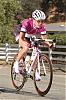
Okay, lots of excitement about the concept of steering with your hips, but I think there's also a bit of confusion, too. Let me try to clarify.
Steering-- Steering refers to minute changes in direction. Steering is not cornering. Steering also includes the ability to ride in a straight line. When I refer to steering with your hips, this means that the bike will move/point in the direction your hips are facing. This assumes that you don't correct this motion with your hands. So, if I drop my hips and point them to the right, the bike will naturally move to the right. When I point my hips in a given direction, my core and shoulders will also point in that direction. Ideally, your head also points in that direction (also referred to as looking where you want to go). The focus, however, is your hips. If you point your hips, your body will follow. If you point your head, your body might follow. Tricky, eh? when I teach this skill, I ask riders to let their pelvis roll off the side of the saddle. I also ask them to unclip their feet so they don't try to counter-steer (see below). Your feet should be completely weightless when you do this.
Cornering -- to corner the bike, we use a skill called counter-steering. Counter-steering is a complex skill, but the corner-stone of being able to corner and descend with confidence. It looks something like this:
- Assuming a right turn, I place my left (outside) leg down and stand on it. This weights the leg and allows the bottom bracket to flex. I'm still seated on the saddle, but you might see a little daylight between my right glute and the saddle. I'm also able to steer by pushing the nose of the saddle with my left (outside) thigh.
- My hands are in the drops and I weight or push the right (inside) hand. You can also unweight or pull the left (outside) hand.
- I allow the bike to lean to the right (inside). This increases the contact patch on the tires which makes the bike more stable. The more you lean, the faster and tighter you can turn. The faster you are turning, the more you need to lean.
- I lean my body to the left (outside), countering my weight on the bike so I'm still over the bottom bracket. If you don't lean to the outside, the bike could slide out from under you.
- I lead with my right (inside) knee. There are actually two schools of thought here. I teach to lead with your knee because this opens up your hips (ie pointing with your hips as in steering). Old school coaches will teach that you grip your right knee against the top tube. This second method just doesn't make sense to me.
- I look around the turn with my entire head (not just my eyes). I refer to this as looking with my chin or leading with my chin. The more you look, the tighter the bike wil turn.
Differences Between Road and Mtn -- The skills we use are essentially the same, however there are some subtle differences between road and mountain, mostly because the terrain is different. For example, in mtn biking, you might make a very tight turn (switchback) that you would probably never do on the road. Most of the differences are really defined by the speed at which you ride (see next bullet).
Speed -- The speed at which we perform a turn really determines how we do it. At slow speeds, we definitely use the bar to assist with steering and cornering. This is because the bike doesn't have enough momentum to corner without using the bar. This means that most times when we're climbing on the mountain bike or the road bike, we use the bar to control direction. When we're descending quickly on the mountain bike or the road bike we would steer with our hips (minute changes in direction) or counter-steer (corners). If we're descending more slowly (ie tight, technical switchbacks) we need to use our hands/head much more than for fast descents.
Welcome guest, is this your first visit? Click the "Create Account" button now to join.


Results 1 to 15 of 28
Thread: Steering with your Hips
Threaded View
-
10-17-2006, 08:54 AM #9
 Registered User
- Join Date
- Jan 2006
- Location
- San Francisco, CA
- Posts
- 1,080
Maybe I should clarify?

 Reply With Quote