bikerHen
 Reply With Quote
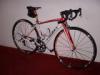
Yeah, I really wanted to pick her up yesterday. But I figured by the time I did it would be too late to get a good ride in. Plus, I wanted to see how I'd do on the club intermediate ride last night. Also, I felt like I need to ride more in order to be deserving of such a fine machine. I'm all a-quiver....
I'm happy to report I was able to stay with the front group last night too! All around, life is good.
Welcome guest, is this your first visit? Click the "Create Account" button now to join.


Results 61 to 73 of 73
Thread: Ruby Comp or Ruby Pro
-
03-22-2007, 07:26 PM #61
 ...just rollin' along
- Join Date
- Jan 2006
- Location
- Sierra Foothills, CA
- Posts
- 1,262
To disable ads, please log-in.
... and it's very purdy too Originally Posted by bikerHen


-
03-23-2007, 05:46 AM #62
Registered User
- Join Date
- Apr 2006
- Location
- Texas
- Posts
- 830
Three and a half hours and counting...
As we must account for every idle word, so must we account for every idle silence." ~Benjamin Franklin
-
03-23-2007, 07:57 AM #63
Registered User
- Join Date
- Jan 2005
- Location
- North Bellmore, NY
- Posts
- 1,346
Originally Posted by li10up
Good for you li10up!!!! I honestly believe you are very deserving of the Pro as anyone else here you would like to own one.
I took off of work yesterday and in between dr. appts, I took a quick 15 mile ride. I am so happy to report that I went through all the gears on both cranks in the front and my chain did not rub on any gear ratio. I do not think I went down to the easiest because I was on a flat stretch and I was spinning like crazy at some point down there and didn't want to fall over. You cannot beat the shifting on this bike. It also has a mechanism on the cable that gives you an idea where you are in the rear.
Ok...I will now await your report when you pick up yours.
~ JoAnn
-
03-23-2007, 07:03 PM #64
YIKES! i'm a durt gurl
- Join Date
- Jun 2004
- Location
- socal
- Posts
- 1,852
carbon bike care
well lookie what i found posted on the specialized rider's club site!
So we have heard lots of questions about carbon fiber these days, and lots of Riders Club members have been writing to ask about caring for their carbon bikes. So us in the Carbon Engineering department sat down and put together this little tip sheet, to help you get the most from your carbon bike or components. Enjoy!
Carbon Tips from the Engineers at Specialized Bicycles
1. Do not use grease on any Carbon seatposts or Carbon seat tubes. What we have started to use in the shop is a product from TACX called Dynamic assembly compound. We have found that this product works very well with all the carbon products.
2. Always use a torque wrench! This is a VERY important tool for carbon fiber frame owners to have. It is much harder to determine the torque on a bolt by feel with carbon than it is with alloy. Overtorquing is probably the biggest cause of cracks that we see in carbon products.
3. It is fine to wash the bikes with soapy water and a hose, and like any bike, it's never a good idea to aim the water directly at bearings (headsets, cranks, etc). We recommend hosing the bike off, then washing with a brush, sponge and a bucket of warm soapy water of diluted Simple Green. Finally, rinse carefully.
4. After a wash, use Pledge furniture polish or something like Pedro's bike lust to put a nice new shine back onto the bike.
5. If you have any stone chips or have had chain suck, then it is a good idea to protect the raw carbon finish with either a clear tape or some clear nail polish.
6. If a frame has been crashed, you should always have it inspected by your dealer.
7. When cutting components (handlebars and seatposts, etc):
- We recommend using a carbon-specific hacksaw blade. These blades essentially “sand” through the carbon instead of tearing through with teeth, which tend to fray and splinter the fibers in the composite. It’s also good practice to wrap the carbon with tape before cutting, though this is less necessary when using a carbon-specific blade.
- Pay particular attention to the orientation of the seat collar. When using a carbon post, it’s very important to have the seat collar slot on the opposite side of the seat tube slot. This helps disperse loads better, reducing the possibility of pinching and crushing the seat post, as well as reducing frame damage. Diagonally slotted seat collars are highly recommended, and proper torque is crucial to long component and frame life.
-
03-23-2007, 07:56 PM #65
Registered User
- Join Date
- Jan 2005
- Location
- North Bellmore, NY
- Posts
- 1,346
Thanks Caligurl!!!!
-
03-30-2007, 08:09 PM #66
Registered User
- Join Date
- Nov 2006
- Posts
- 14
Bionica
Hi,
I have the Ruby Expert. an absolute dream of a ride. I wouldn't trade it for anything. It is a nice "middle ground" between the comp and the pro. I think you would love it just as much as I do. I always ride with a smile when I am out on my Ruby. I have a winter bike, a specialized Dolce.....feels like a tank compared to my Ruby. I don't rode the Ruby in the rain. Go for the Expert, it is a great ride.
-
04-02-2007, 10:43 AM #67
Registered User
- Join Date
- Apr 2006
- Location
- Texas
- Posts
- 830
Over 100 miles
Update: I have over 100 miles on the Ruby Pro now. She rides like a dream! I've lost quite a bit of downhill coasting speed but am doing better on the hills. My avg. speed on a 30 mile ride yesterday was 15.5. That's faster than I normally average on a 20 mile ride...and this ride had some hills on it...one pretty serious. I am loving this bike. I've found I can put about 5 more psi in the tires than on my Allez without sacrificing comfort. The Ruby really smooths out the ride! I might even try a few more psi. On the Allez I was at 95 psi and rode the Ruby yesterday at 100 psi. I can go up to 110 psi on the tires. Standing on hills is a completely new experience. When I did it on the Allez I felt like I was pulling something uphill. With the Ruby that feeling is gone. It takes much less effort to stand on the hills. I may be in love with a bike!

Thanks for the carbon care info!!!As we must account for every idle word, so must we account for every idle silence." ~Benjamin Franklin
-
04-02-2007, 11:05 AM #68
Registered User
- Join Date
- Jan 2005
- Location
- North Bellmore, NY
- Posts
- 1,346
Thanks for the update li10up!!! I have yet to try some hills on mine.
I am happy to hear you are truely happy with your decision in buying the pro.
~ JoAnn
-
04-02-2007, 11:35 AM #69
listen to the bees
- Join Date
- Jul 2006
- Location
- Riding my Luna & Rivendell in the Hudson Valley, NY
- Posts
- 8,411
Li10up,
Congrats on your beautiful new bike!
I am curious though...why is it that you "lost quite a bit of downhill coasting speed"- what causes that?
I look forward to a day when I don't feel like I'm pulling my bike uphill. I suspect I need stronger leg muscles!Lisa
My mountain dulcimer network...FOTMD.com...and my mountain dulcimer blog
My personal blog:My blog
^^^^^^^^^^^^^^^^^^^^^^^^^^^^^^^^^^^^^^^^^^^^^^^^^^^^^^^^^^^^^^^^^^^^
-
04-02-2007, 01:12 PM #70
Registered User
- Join Date
- Apr 2006
- Location
- Texas
- Posts
- 830
Lisa, due to the bike weighing quite a bit less I don't have the momentum of that extra weight in effect pulling me downhill. That's why larger riders can coast downhill faster than light riders. I call my rotundness "superior coasting weight." A lighter bike is essentially the same thing. I'm hoping to make up the difference on the rest of the ride though...on the flats and hills. Originally Posted by Lisa S.H.
As we must account for every idle word, so must we account for every idle silence." ~Benjamin Franklin
-
04-02-2007, 04:51 PM #71
Registered User
- Join Date
- Sep 2006
- Location
- Washington, DC
- Posts
- 1,315
Just get more aero on the downhills and you can coast pretty fast. I can usually keep up with the 53/11t gearing lot after I've run out of gears at 50/12t just by getting into a more aero position.
-
04-02-2007, 04:59 PM #72
Registered User
- Join Date
- Apr 2006
- Location
- Texas
- Posts
- 830
That's what I do...unfortunately that's what my riding buddies do too so I can't gain an edge. Oh well, it's a problem I don't mind having if it means having a lighter bike with better components. Originally Posted by aicabsolut
As we must account for every idle word, so must we account for every idle silence." ~Benjamin Franklin
-
04-02-2007, 07:18 PM #73
Registered User
- Join Date
- Sep 2006
- Location
- Washington, DC
- Posts
- 1,315
Yeah, it will only do you so much good if your riding buddies have a significant weight advantage over you. Getting low so far helps me hang on in a race. I guess you'll have to stop coasting so much.