+1 for the leverage recommendation. We have a massive pair of vice-grips that get pressed into service for tricky cassette removals.
Also, does your cassette tool have the little "guidepost" or does it have a hole in the center? If it has the hole, using your QR to hold the cassette tool in place can help keep everything together and allow you to torque on it a little more.
Good luck!
Welcome guest, is this your first visit? Click the "Create Account" button now to join.


Results 1 to 14 of 14
Hybrid View
-
10-12-2009, 05:26 AM #1
 Registered User
- Join Date
- Mar 2008
- Posts
- 2,698
-
10-12-2009, 01:29 PM #2
Registered User
- Join Date
- Feb 2009
- Posts
- 106
Thanks for the tips.
My cassette remover does have a "guidepost".
The handle I used is only 20 cm long (7.87"). I better get a longer one.
I check that the max torque to lock the cassette is 40Nm. Based on my calculation, it means that I need to apply 200N force (~ 20.4 kg weight!)
-
10-13-2009, 10:09 AM #3
Registered User
- Join Date
- Sep 2009
- Posts
- 5
Definitely get the big handle - mine is massive and allows the force to unlock it Originally Posted by wildeny

-
10-13-2009, 11:08 AM #4
Registered User
- Join Date
- Aug 2008
- Posts
- 2,841
If you've got a metal pipe, you can slip it over the end of your handle to get more leverage. Originally Posted by wildeny
-
10-13-2009, 06:34 PM #5
Registered User
- Join Date
- Feb 2009
- Posts
- 106
Yesterday I got the adjustable wrench with a 30-cm handle (quite heavy one).
I still couldn't turn the remover.

I asked a mechanic in my office to help me. Finally the cassette was off. (I think the lbs did tighten it too much.)
I practiced a little bit on installing and removing the cassette. Then the mechanic & I disassembled the hub (I also wanted to learn it). Initially we just wanted to clean the inside and put all the parts back, but then he found one skewer was damaged.
I talked to the lbs about my damaged part (I brought those parts to them*), but the lbs said I have to give them the complete rear wheel (with everything installed back) to them so that they can return it to the manufacturer. (they don't like people DIY
  )
)
PS I only have bicycles to go around so I can't carry a wheel with me on bike.Last edited by wildeny; 10-13-2009 at 06:43 PM.
-
10-13-2009, 11:11 PM #6
Grizzled
- Join Date
- Sep 2006
- Location
- Oslo, Norway
- Posts
- 4,066
good for you for finally getting the cassette off. It's really not supposed to be hard, so it's good to install and remove a couple of times yourself so that you get a feel for it.
If only the skewer was damaged it's bizarre that they want the whole wheel back! If I have the English terminology right, it's hardly a part of the wheel at all, but an interchangeable part like the tire.
Oh well, good luck. If you have a backpack you can ride with a wheel strapped to it without too much trouble.Winter riding is much less about badassery and much more about bundle-uppery. - malkin
1995 Kona Cinder Cone commuterFrankenbike/Selle Italia SLR Lady Gel Flow
2008 white Nakamura Summit Custom mtb/Terry Falcon X
2000 Schwinn Fastback Comp road bike/Specialized Jett
-
10-15-2009, 03:42 AM #7
Registered User
- Join Date
- Feb 2009
- Posts
- 106
I checked Sheldon's site and learned the name of that part: cone.
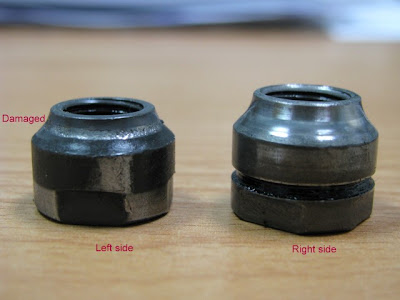
I wonder whether this is due to the poor adjustment applied by the manufacture or the over-tightness on the quick release skewers by the lbs.
The first time when I tried to take out my wheels, it took me lots of effort to bend the handle of the QR.
-
10-15-2009, 04:00 AM #8
In-app purchases
- Join Date
- Sep 2007
- Location
- Uncanny Valley
- Posts
- 14,498
It should take a lot of effort to open and close the QR. You don't want it coming open spontaneously, or easily when you brush up against something. The rule I usually hear is that closing the QR should leave a mark on your hand.
Loose bearing assemblies need to be kept in adjustment and re-greased periodically. Generally, the cheaper the assembly, the poorer the tolerances it was built to, and the more fiddling it's going to need. It's definitely possible they were over-tightened at the factory, but it's a lot more likely that the locknut came loose over time. How many miles on the hubs? How many years (years would only matter if it's getting up over 5-ish; most grease will degrade over time, but slowly). Did they have a lot of miles in heavy rain, or is it possible you or someone else washed the bike with pressurized water and got water into the hubs?
I would expect the mfr would want the whole wheels back to see for themselves the type of damage to the cones (pitting, scoring, something else) and also whether the cups were also damaged. And also, as you say, because if it's going to be a warranty claim, the LBS doesn't want the mfr claiming that you disassembled it and overtightened it yourself.Last edited by OakLeaf; 10-15-2009 at 04:04 AM.
Speed comes from what you put behind you. - Judi Ketteler

 Reply With Quote