


 Reply With Quote
First off, do whatever feels right to YOU. He's not the one riding the bike.
I'd say he's never ridden a compact crankset. On my compact, I'm often in the big ring, and only use the small ring when there are significant climbs. It's pretty flat where I am, and so I'm often in the big ring for the entire ride.
On my bike with a regular triple, I'm more often in the middle ring, and sometimes in the big ring.
But really, you should do whatever is best for you.
Welcome guest, is this your first visit? Click the "Create Account" button now to join.


Results 1 to 15 of 23
-
08-27-2009, 09:16 AM #1
 Registered User
- Join Date
- Aug 2009
- Location
- Dallas
- Posts
- 5
Compact Gear, Big ring vs Little ring
To disable ads, please log-in.
This is my first post, and I have only been riding a few months. My need to settle an ongoing dispute with my much more experienced moutain biking boyfriend has driven me to this post. I am riding a Specialized Dolce Comp. I feel that my ride is much easier to maintain speed and comfort level when I am in the big gear up front and about mid range in the back. This is of course flat road. When a hill comes up, I downshift to the small gear up front. My boyfriend is CONSTANTLY nagging me to ride in the little gear most of the time - even on flat roads. I have told him again and again that I am more comfortable in the bigger gear as I do not feel tired and I do not have to maintain a higher cadence that I would in the little gear. I am in good shape to start with (ie. weight training, cardio, VO2 Max test was 60% for my age group). So its not like I wasn't active before I started riding the bike.
My question for you, if you are riding a compact, what gear do you usually use on the flat roads - big or little?
-
08-27-2009, 09:25 AM #2
Ain't Love a Surprise?
- Join Date
- Nov 2005
- Location
- Between the Blue Ridge and the Chesapeake Bay
- Posts
- 5,203
-
08-27-2009, 10:14 AM #3
Meow!
- Join Date
- Sep 2006
- Location
- Central Indiana
- Posts
- 6,034
I'd echo what Tulip said. While I often used the middle ring of my triple, I'm almost always in my big ring on my compact. Even for short climbs, I don't bother to shift to the smaller ring. Putting the rings themselves aside, use whatever gear feels most comfortable to you given your preferred cadence, the terrain, wind conditions, etc. So long as you're not cross-chaining, it doesn't really matter what ring/cog combo you use to get there. Originally Posted by tulip

Has he said why he thinks you should always be in the little gear? If he's trying to get you to avoid cross-chaining, I can understand his point (my BF nags me because of that). Otherwise, I'd just tell him to buzz off! Live with intention. Walk to the edge. Listen hard. Practice wellness. Play with abandon. Laugh. Choose with no regret. Continue to learn. Appreciate your friends. Do what you love. Live as if this is all there is.
--Mary Anne Radmacher
-
08-27-2009, 10:35 AM #4
Registered User
- Join Date
- Aug 2009
- Location
- Dallas
- Posts
- 5
Thanks for the quick replies! I just wanted confirmation as it is little daunting to be a newbie with no experience. I definitely change gears based on how I feel. It is just frustrating when someone tells you it is still the wrong gear. Even with no experience, I still know how I feel better than he would know how I feel. To answer your question, he tells me to use the smaller gear because the bigger gear takes more power and will cause exhuastion. It has nothing to do with the cross chaining. He has taught me not to do that so I try to refrain from cross chaining. I say the little gear causes my legs to tire quickly because I have to have a much higher cadence to keep the same speed. To me, it's like sprinting! And if I don't feel exhaustion on the big ring, why not use it? It just FEELS right to me.
-
08-27-2009, 11:06 AM #5
Registered User
- Join Date
- Aug 2008
- Posts
- 2,841
I use the big chain ring except when going up a hill on my compact double... and on my triple.
-
08-27-2009, 11:17 AM #6
Grizzled
- Join Date
- Sep 2006
- Location
- Oslo, Norway
- Posts
- 4,066
I rarely think about which ring I'm using, I just go by feel. I have a cadence I'm accustomed to, but I'll try to push myself every now and then just to feel what spinning feels like, and what slow pedalling feels like. If you feel that you've already found a cadence that is efficient, maintains your speed, and feels comfortable, you're doing it right. Your preferred cadence may change as you ride more, and on different terrain, but people do have different inherent preferences. I don't like sprinting either, but I do it a bit more now than I used to.
(I'm assuming you're not racing here, and he's not acting as your coach. )Winter riding is much less about badassery and much more about bundle-uppery. - malkin
1995 Kona Cinder Cone commuterFrankenbike/Selle Italia SLR Lady Gel Flow
2008 white Nakamura Summit Custom mtb/Terry Falcon X
2000 Schwinn Fastback Comp road bike/Specialized Jett
-
08-27-2009, 12:47 PM #7
Registered User
- Join Date
- Aug 2009
- Location
- Costa Mesa, CA
- Posts
- 50

I'm a newbie too, but I thought that I should add that, while you should absolutely do what feels right to you, a higher cadence does have it's benefits. With practice, many people find it easier to maintain an even pace and high cadence riding is widely preached, so it's not surprising that someone might steer you towards that. However, you definitely should not be spinning so fast that you are bouncing in the saddle or feel out of control. I seem to like 80-85 rpm the best, which is far from spinning wildly but is a pace I still have to think about to maintain at my current riding level. I had to move down a gear to maintain the rpm (I used to ride at about 60 rpm) but after a few rides, my overall pace has increased.
On other hand, mashing on a higher gear does have the potential to hurt your knees, even when you don't think that you are pushing that hard. Over time the effects can add up. Not that you are mashing a high gear, but it’s something to experiment with. There is a personal balance that each rider must find for themselves.
Also, there is some overlap of the gain ratios from the small to large ring so depending on what gain ratios you feel comfortable riding in, you might be able to dial in a similar gear using the small cog. You just have to move your chain on the rear cogs appropriately so that you don't jump down a huge percentage and spin wildly. I have found that knowing the gain ratios for my gearing really helps.
I’m a collect evidence kind of gal so personally I would look up your gain ratios and those for his bike and compare. Maybe he doesn’t realize what your gearing feels like and how it might be very different from his. Of course if the evidence does not support my position . . .it disappears before he sees it.
Good luck getting your BF to lay off!
-
08-27-2009, 04:05 PM #8
Registered User
- Join Date
- Jul 2008
- Location
- Chicago suburbs
- Posts
- 1,222
I ride a compact, and ride mostly in my big ring up front...even for a small climb. I don't live in a particularly hilly area, although most of my routes do involve some steeper hills that require me to drop down to the small ring. There are even a few hills, that require me to be in my lowest gear and just spin my heart out just to make it up to the top. Climbing is not my forte, so I try to focus on staying seated, sitting up nice, tall, and relaxed, taking in lots of oxygen, and just spinning at a higher cadence until the hill flattens out. But there are a few hills I encounter, where staying seated simply won't cut it...and for those I'll come out of the saddle.
-
08-27-2009, 04:35 PM #9
Registered User
- Join Date
- Feb 2009
- Posts
- 106
For a road bike with a compact, I often ride on the small ring either on the flat or hilly road (& it could be quite hilly in my area). Only ride on the big ring on the downhill road (small slope). Originally Posted by Kay76310
Kay76310, I often rode on the big ring before and preferred on the large gear ratio, while my friend who ride a MB preferred on the lower gear ratio. Later I found that riding on a lower gear ratio with higher cadence did help retain my strength. It doesn't make me faster immediately -- maybe a little bit, I don't know the real factor -- but on a long ride, it certainly helps on my average speed since I don't feel tired so quickly. Besides, it does put less strain on your knees and muscles around them.
Anyway, it's just a habit how you like to ride your bike. However, I believe that if you want to improve your overall speed, then a lower gear ratio with a higher cadence is the way to go. But it matters little for a casual ride. You can see this blog post, "Optimal Cadence".
-
08-27-2009, 04:51 PM #10
Addicted to wheelsucking
- Join Date
- Sep 2006
- Location
- Phillipston, MA
- Posts
- 445
I ride a triple. I am mostly in my big ring. I drop to the middle ring once and a while and I am in the small ring very infrequently.
However, it is a bit different in March and April when I am just getting out when I use the middle and small ring more.
-
08-29-2009, 09:19 PM #11
Registered User
- Join Date
- Jul 2009
- Location
- Portland, OR
- Posts
- 324
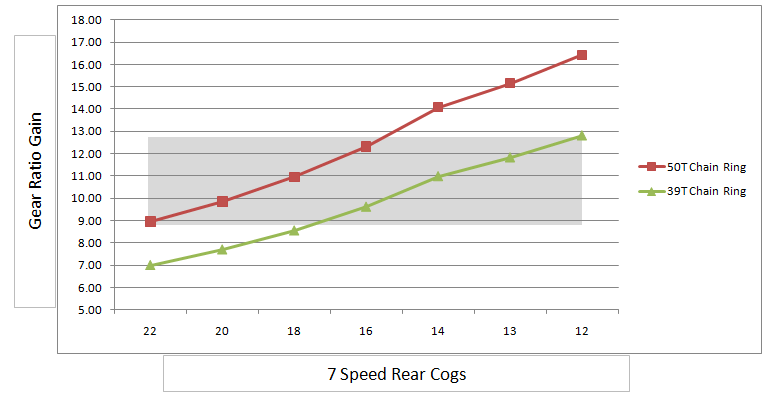
Being rather OCD and nerdy at times, maybe seeing how much overlap there can be between two chain rings. The numbers are based on my road bike set up with 50/39 chain rings and a 7sp cog set of 12-22. The "ratio" numbers are based on Sheldon Brown's gain ratio formula (I have 175 cranks and 700x23 tires).
Maybe seeing that you do have overlap between the front chain rings will help ease the argument of which one you "should" use. Which the answer as others have said is what ever feels good to you for the terrain you are riding.
Happy riding.
-
08-30-2009, 05:30 AM #12
Meow!
- Join Date
- Sep 2006
- Location
- Central Indiana
- Posts
- 6,034
To the OP, do you have any idea what cadence you feel comfortable with? I agree in theory with your boyfriend. A higher cadence, say around 90 rpm, is generally better from an endurance standpoint. I disagree, however, that you necessarily have to be in the little ring of a compact crank to achieve that. I can easily do so in my big ring. Now, you may have to build up to that, but in time, you should be able to comfortably use a wider number of your available gears.
Live with intention. Walk to the edge. Listen hard. Practice wellness. Play with abandon. Laugh. Choose with no regret. Continue to learn. Appreciate your friends. Do what you love. Live as if this is all there is.
--Mary Anne Radmacher
-
08-30-2009, 09:14 AM #13
Starting Out
- Join Date
- May 2009
- Location
- Minnesota
- Posts
- 96
Sheldon Brown's Gear Calculator: http://www.sheldonbrown.com/gears/ - this is *great* to play around with to get the optimal setup in gearing for your bike. Right now I am playing around with how to change my commuter / errand bike to be able to haul more stuff uphill.
Unfortunately it doesn't save the output as a link - it is dynamic within the page.
For the 2010 Dolce Pro compact at least:
* Wheel Size: 700c x 23
* Crank Length: 170mm (I am assuming)
* Gear Units: Gain Ratios (for every circle the crank makes, the gain ratio is the multiplier to determine distance traveled -- you can use any units you like here, like light-years, since it is a ratio!)
* Chain Rings: 50, 34
* Stock Cassette: 10 speed, 12-27
**Calculate**
chrng ** 12 ** 13 ** 14 ** 15 ** 16 ** 17 ** 19 ** 21 ** 24 ** 27 cog
* 50 * = 8.2 * 7.6 ** 7.0 ** 6.5 ** 6.1 [5.8] [5.2] *[4.7] * 4.1 ** 3.6 GR
* 34 * = [5.6] [5.1] [4.8] * 4.5 ** 4.2 * 3.9 ** 3.5 * 3.2 * 2.8 ** 2.5 GR
You essentially have 15-16 unique gears; three that are nearly the same, and two that alternate.
50 x 17 [GR 5.8] ~= 34 x 12 [GR 5.6]
50 x 19 [GR 5.2] = 34 x 13 [GR 5.1]
50 x 21 [GR 4.7] = 34 x 14 [GR 4.8]
The "most ideal" shifting would be to have the least cross-chaining: shift from 50 x 21 (skipping the largest two cogs) to 34 x 14 (skipping the smallest two cogs) -- nearly identical gain ratios of 4.7 / 4.8. Practically speaking, it is easiest to stay on one chainring, hit the end of the cogs, and then shift, unless you can remember what gear you are in. I'm assuming with compact doubles cross-chaining is less of a problem (I don't have one). So 34 x 12 is similar to 50 x 17, gain ratios of 5.6 / 5.8. If you keep going down in the 50 ring, your cog sizes are much larger, and you will drop a lot in speed at the same cadence. Your drop in gain ratio / speed is less on the 34 ring. (You can also play with speed at various cadences.)
If you switch to a 12-25 cog, then the jump in cog sizes is less for the larger cogs, and there would be more "overlap" in gain ratios between the 50 chainring and 34 chainring. You would essentially have 14-15 unique gears (and the lowest gear, 34 x 25, would be higher than 34 x 27). But it would be just as effective to stay on the 50 ring, since the drop in gain ratios at the larger cog sizes will be less, and will overlap the gain ratios in 34 chainring and smallest cogs. I think it is more typical to have 12-25 cogs, they probably set up the women's bike with 12-27 to give a lower gear for climbing. Most women have a lower power/mass ratio to men, since on average women have a higher fat % / lower lean mass % than men. With 12-25 cogs, you have the option to stay in the larger chainring or the smaller chainring without a "gap" / higher drop in gain ratio in the 50 x larger chainrings.
The other option is shorter cranks. Since women are typically smaller and have shorter legs, shorter cranks are more effective. The smaller revolution puts less strain on the knees, important since this is the most common repetitive strain injury. Really, women's bikes should have shorter cranks standard -- unfortunately it is difficult to even find shorter cranks, and they are expensive (check out Peter White Cycles for one source). The best method is to measure the femur (in mm), from the top where the ball sits in the hip to the knee, and multiply by 18.5%. You can also use your inseam measurement in mm, multiply by 2% to 2.16%. If you take a 160 mm crank arm, for example, in the 12-27 cogs, your drop in gain ratio would be less on the larger cogs in the 50 chainring, and overlap the gain ratios on the 34 ring on the smaller cogs. Your speed in a gear at the same cadence will be the same in a 170 mm crank or a 160 mm crank. If your legs are shorter, the strain on your knees will be less (smaller circles), you would have all the gears as before, and your preferred shifting pattern of staying in the larger ring will work better.
I have a 52 / 42 / 32 triple x 8 cogs (24 speed), with 14 unique gears. I stay on the middle chainring, and then 52 x the three smallest cogs and 32 x the 3 largest cogs are the "extension" of the middle chainring, = 8+3+3 gain ratios. This makes shifting much easier, since I hit the end of the middle cog, switch to the larger / smaller one, and and then click up or down 2 cogs to get the next gear. With a compact double, you can hit the end of the cog, but to get to the next gain ratio up / down, you need to be in the middle of the other chainring. Now I understand why Campy went to having the 5 up / 3 down shift option on cogs!
-
08-30-2009, 09:30 AM #14
Starting Out
- Join Date
- May 2009
- Location
- Minnesota
- Posts
- 96
Another note about switching crank sizes -- your gain ratios will not change much in lower gears, but will change a lot in higher gears. If your favorite gear right now is 50 x 17 for example (gain ratio of 6.1), on a 160 mm crank the equivalent gain ratio of 6.1 is 50 x 16. Your gain ratio will be pretty much the same in lower gears. At the high end, the gear ratio for 50 x 12 will be 8.7 on 160 mm cranks vs. 8.2 for 170 mm cranks. I don't think this is a bad thing -- you usually use the highest gears downhill, and you won't spin out as fast with higher gain ratios in your "downhill" gears.
-
08-30-2009, 10:48 AM #15
Clueless
- Join Date
- Dec 2008
- Location
- Maryland
- Posts
- 147
I'm glad this was brought up because I'm always pondering if it would be more beneficial for me to stay in the small chainring most of the time with my lack of speed/strength. Typically on flats I find myself hanging out on my large chainring (50/34) and 21t cog in the back. I can easily hold about a 82 rpm cadence with this gearing. With some tinkering with gear calculators, I see that I can get the same gear ratio on the small chainring and the 14t cog. My worry would be running out of gears on the small chainring very quickly especially on rolling hills.
And now that I just rambled I highly doubt I made a point (or made any sense)...






 Posting Permissions
Powered by vBulletin® Version 4.2.2
Copyright © 2026 vBulletin Solutions, Inc. All rights reserved.
Copyright © 2026 vBulletin Solutions, Inc. All rights reserved.
All times are GMT -8. The time now is 11:18 PM.
vBulletin Skin By: PurevB.com