

How did the club obtain their data?
Welcome guest, is this your first visit? Click the "Create Account" button now to join.


Results 1 to 15 of 39
Thread: Motion Based Question
Hybrid View
-
10-20-2008, 03:36 PM #1
 In-app purchases
- Join Date
- Sep 2007
- Location
- Uncanny Valley
- Posts
- 14,498
Speed comes from what you put behind you. - Judi Ketteler
-
10-20-2008, 04:04 PM #2
droppin' off the back
- Join Date
- Aug 2008
- Location
- St. Louis, MO
- Posts
- 1,058
I have a Garmin Forerunner 305. I've never paid much attention to the altitude until my century. I got a 6800 ft altitude change, and saw others as low as 5800 ft altitude change on the same ride. I have the autocorrect on because it is recommended. When I turned on elevation correction, it lowered it to 6300 ft.
I'm also curious what other do about this. How do I know what's accurate?"Well-behaved women seldom make history." --Laurel Thatcher Ulrich
'09 Trek WSD 2.1 with a Brooks B-68 saddle
'11 Trek WSD Madone 5.2 with Brooks B-17
-
10-20-2008, 04:17 PM #3
Inner Geekette
- Join Date
- Aug 2003
- Location
- Bendemonium
- Posts
- 9,673
Mr. Silver, your results absolutely make sense. It's all on the algorithms, and how frequently the device is recording and a number of other whizbang mathematical stuff that confuses me. You'll see the same problem when comparing to many websites that are just using GPS data. So read onward . . . .
cunninghamair, barometric altimeters must be used to get readings at all accurate. The Forerunner 305 does not have one. Do some searches on this forum and over on bikejournal for more discussion.
I've used Polar and Ciclo which also have barometric altimeters with very consistent results with my Edge 305 run through GTC and now SportTracks. So, I'm comfortable using those numbers. Accuracy is in the eye of the beholder, it's pretty unanimous that a barometric altimeter is required to get close. Just remember that weather patterns can cause some inconsistency, but generally not as much as GPS-only data.Frends know gud humors when dey is hear it. ~ Da Crockydiles of ZZE.
-
10-20-2008, 04:31 PM #4
In-app purchases
- Join Date
- Sep 2007
- Location
- Uncanny Valley
- Posts
- 14,498
The Forerunners do not have the barometric altimeter, so for those, MotionBased recommends that you turn on the Gravity correction.
We went for a hike in the woods this afternoon. I was hoping the slower speeds of hiking might bring all the results closer - not so. I brought my Edge 705 with me (partly for the barometric altimeter, partly because of the receiver that's much more sensitive than my Forerunner 301). Even so, with the tree cover, the reception was poor. So everything's going to be off - but FWIW, the data displayed in the unit called it 5.1 miles with 727 feet of elevation gain. GTC calls it 5.1 miles with 863' of climbing (and 859' of descent to the start point, so pretty close on the net anyhow). SportTracks calls it 5.98 miles with 1053' climbing (but only 956' descent!). MB, with autocorrect on and Gravity off, calls it 5.94 miles and +1076/-1050.
As far as speed smoothing, GTC had a max speed of 4.5 mph (probably about right); ST says max speed of 19.1 mph! (I hate to turn the smoothing up because it honestly seems pretty accurate on the bike - wish it would let you set smoothing differently for different sports). MB didn't smooth that spike out too well either - it gives me a max speed of 17.2.
What's the most accurate? Who knows - only thing I know for sure is that the max speeds on ST and MB are in need of some serious smoothing.
EDIT: I realized that I still had my 705 turned to smart recording. Probably for a hike, especially under tree cover, it would've been a lot better to set it for 1 second recording. Doh.Last edited by OakLeaf; 10-20-2008 at 04:58 PM.
Speed comes from what you put behind you. - Judi Ketteler
-
10-20-2008, 06:09 PM #5
Inner Geekette
- Join Date
- Aug 2003
- Location
- Bendemonium
- Posts
- 9,673
Doh! Originally Posted by OakLeaf

Anytime I have satellite issues, all bets are off for anything to interpret the data.Frends know gud humors when dey is hear it. ~ Da Crockydiles of ZZE.
-
10-20-2008, 05:14 PM #6
f/k/a Mr. S.
- Join Date
- Dec 2006
- Location
- Blessed to be all over the place!
- Posts
- 3,433
I'm presuming GeoBike is a different vendor, but it does raise the question of whether we're comparing equally errant sources Originally Posted by OakLeaf
If you don't grow where you're planted, you'll never BLOOM - Will Rogers
-
10-20-2008, 05:36 PM #7
"Ride lots!"
- Join Date
- Oct 2002
- Location
- San Francisco Bay Area
- Posts
- 9,324
I've seen rides where riders are asked to submit their data from Polars, GPS units, whatever... I assume the ride organizer looks at all the numbers and makes some determination.
Did you see this for the Hilly Hundred?
http://www.hillyhundred.org/PDF_Files/Hills.pdf
Those aren't hills; most of those are rollers.
Remember max incline could be from one spot on the hill, not the entire hill. It would be like saying our Mount Diablo is a ten mile 18% climb, just because the last tenth of a mile is 18%.
Veronica
-
10-20-2008, 06:17 PM #8
Inner Geekette
- Join Date
- Aug 2003
- Location
- Bendemonium
- Posts
- 9,673
Hey, Ms Teacher. Did you do the math? How do you use your momentum to "roll" over a grade that is well over three times the length of a football field. Nothing is shorter than .2 miles or 1,056 ft or 352 yards or 3.52 football fields. Originally Posted by Veronica
Frends know gud humors when dey is hear it. ~ Da Crockydiles of ZZE.
-
10-20-2008, 06:33 PM #9
"Ride lots!"
- Join Date
- Oct 2002
- Location
- San Francisco Bay Area
- Posts
- 9,324
Originally Posted by SadieKate
No, I did not do the math.
It's all in you definition of hill. If it takes me just a few minutes to get over it, it's not a hill. My 27 mile ride with 1,280 feet of climbing gets labeled rollers, not hills because none of the hills take very long to get over. Not even the ones that require me to go into my small ring.
Veronica
-
10-21-2008, 03:29 AM #10
In-app purchases
- Join Date
- Sep 2007
- Location
- Uncanny Valley
- Posts
- 14,498
okay - we've wrangled over what's a "hill" before (I think probably NOBODY except for Alpinerabbit would claim they ride "mountains" - don't we have anyone in the Rockies?)
But now the gauntlet's laid down.
V., come over here and ride the Columbus Fall Challenge next year (provided they hold it - they've had organization trouble the last couple of years). I'll train and do it with you. Similar type of terrain to the Hilly, but about 1.5x more climbing per mile, and 110+/- miles each day. That's a ride I was afraid to do when I was racing and I'm still a little afraid now that I'm braver but not nearly as strong. But I challenge you to do that ride next year and THEN say they're not hills.Speed comes from what you put behind you. - Judi Ketteler
-
10-21-2008, 03:53 AM #11
"Ride lots!"
- Join Date
- Oct 2002
- Location
- San Francisco Bay Area
- Posts
- 9,324
Sorry, I can't travel to Columbus Ohio in the middle of the school year.
You could come do DMD with me in April.
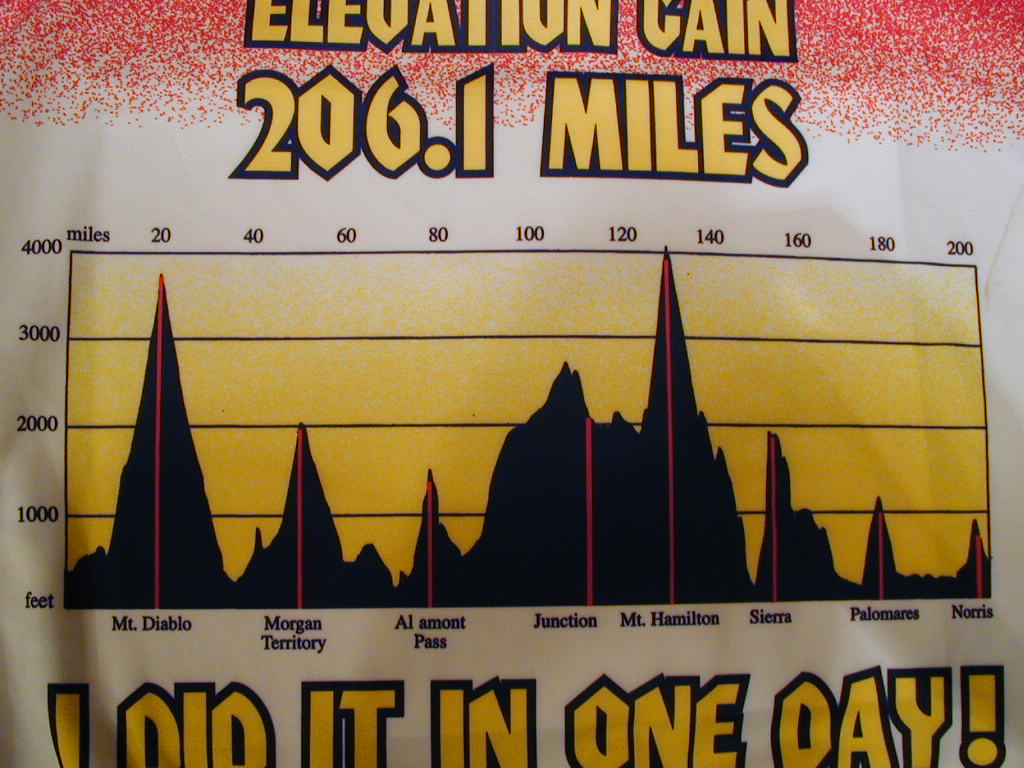
I'm hoping to finish this time. In 2006 I got to the top of Mt. Hamilton and my lower back quit. It's a lot stronger now.
In this profile - Diablo and Hamilton are mountains, all the rest are hills. Of course others opinions will vary. I do label this ride steep at BJ because of the nature of the hills.
VeronicaLast edited by Veronica; 10-21-2008 at 03:55 AM.
-
10-21-2008, 06:15 AM #12
"Ride lots!"
- Join Date
- Oct 2002
- Location
- San Francisco Bay Area
- Posts
- 9,324
Originally Posted by Veronica
Do people not notice Smiley Faces? I wasn't dissin anyone's terrain.
It's very different from where I typically ride. I'm always surprised at how high the reported average speeds are for these rides in the Midwest with the amount of climbing that they have. Since it's not the sort of stuff I ride, I'm trying to reconcile the numbers in my brain. So here's my current thinkin'...
On a climb like Diablo, I'll average between 7 and 8 miles an hour for ten miles. The descent doesn't allow me to make up much speed because it's so twisty. I'll average around twenty, maybe twenty-two if I'm lucky and feeling brave, on the descent.
In that link I posted there's only 6 miles of climbing on Saturday's route. I assume that same 7 - 8 mile an hour climbing pace, although because the climbs are shorter, a rider could climb faster. I also assume that the downhills are less twisty. I haven't been there, so I could be wrong But if that is true, a rider would get more speed on the downhills and maybe average closer to 30 mph. That would all lead to a much higher average speed than I get on a typical ride with 3,500 feet of climbing.
Like I said it's very different from where I ride.
Veronica

 Reply With Quote



 Posting Permissions
Powered by vBulletin® Version 4.2.2
Copyright © 2026 vBulletin Solutions, Inc. All rights reserved.
Copyright © 2026 vBulletin Solutions, Inc. All rights reserved.
All times are GMT -8. The time now is 07:11 AM.
vBulletin Skin By: PurevB.com