

Info on cleat position and shoes. Overall, though, it's a matter of comfort. Keep in mind that your feet are probably not identical, so even if your cleats are positioned the same on the shoes, you will need to move them based on where the ball of your foot actually is in each shoe. If they feel uneven, work to make them feel more the same. There should be no unnatural orientation with toes in or out for your biomechanics. You shouldn't have hot spots on the balls of your feet. You should be able to pedal at a high cadence easily. You shouldn't feel like the orientation of your feet on the pedals forces you to pedal too slowly (usually, cleats too far back) or to lose power (often cleats too far forward).
As for pedaling in circles, there are other ways you can visualize this. Some people think about the legs moving as pistons versus having a smooth pedal stroke. Don't just push down. You want to pull up too. But what about those "dead" spots? Just about everyone will have them around the top of the pedal stroke, which is why some cranksets are designed with oval or quasi-elliptical chainrings to help keep tension on the chain during the dead spot where you are using smaller muscle groups like the hip flexors in transition between the larger groups: hams and quads. At the bottom of the pedal stroke, there could also be a dead zone, but this one is easier to combat. Some people try to visualize scraping something off the bottom of the shoe as they pull their foot underneath them towards the upstroke. This ensures that you won't be too toe down at the bottom of the pedal stroke. Your ankle should move in a natural motion throughout.
As for speed, there is no rule. Go however fast you want, given your fitness level and the terrain!
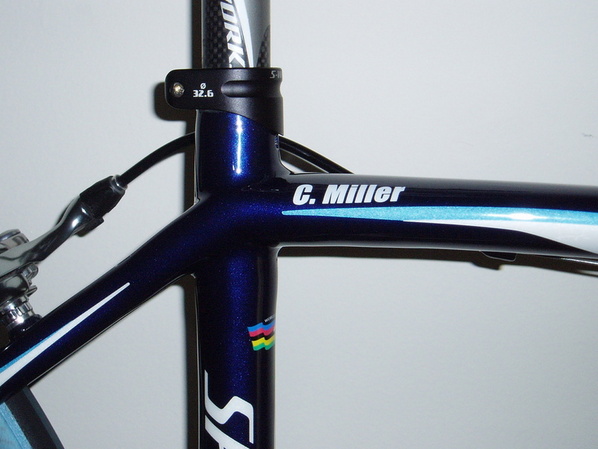
Lots of people name their bikes.
Stickers can be fun too, like mine
Welcome guest, is this your first visit? Click the "Create Account" button now to join.


Results 1 to 8 of 8
Threaded View
-
08-26-2008, 07:52 AM #4
 Registered User
- Join Date
- Sep 2006
- Location
- Washington, DC
- Posts
- 1,315


 Reply With Quote