Reply With Quote
My two cents: in a narrow path, anyone should be careful about allowing others to go through (whether coming in the opposite direction or from behind, moving faster) -- seeing you come in the opposite direction, the other people should have moved to single file.Originally Posted by alpinerabbit

Welcome guest, is this your first visit? Click the "Create Account" button now to join.


Results 1 to 15 of 30
-
05-12-2008, 06:01 AM #1
 wannabe submarine gazelle
- Join Date
- Sep 2005
- Location
- Switzerland
- Posts
- 2,032
am I allowed my lane on the bike path?
To disable ads, please log-in.
Today I sortof waved two people over (with a nod of my head) who were riding side by side, coming against me, so I did not have to slow down, and reaped a "whoa" from them -
so question: am I allowed my lane in the bike path?It's a little secret you didn't know about us women. We're all closet Visigoths.
2008 Roy Hinnen O2 - Selle SMP Glider
2009 Cube Axial WLS - Selle SMP Glider
2007 Gary Fisher HiFi Plus - Specialized Alias
-
05-12-2008, 06:18 AM #2
Registered User
- Join Date
- Sep 2006
- Location
- Washington, DC
- Posts
- 1,632
-
05-12-2008, 06:51 AM #3
Small world, big life!
- Join Date
- Apr 2006
- Posts
- 3,867
Yeah, but nobody ever does. It's one of my pet peeves, especially with walkers taking up the whole path--whether in the mall or the baseball stadium or the bike path.
I've taught all my children to walk single file behind me when we are walking in pedestrian traffic. I guess I'm too nice.
Karen
-
05-12-2008, 07:33 AM #4
zippadee-doo-dah
- Join Date
- Apr 2007
- Location
- Limbo
- Posts
- 8,769
Of course you are! Originally Posted by alpinerabbit
Would they walk into oncoming traffic and expect cars to stop for them?
.
2008 Trek FX 7.2/Terry Cite X
2009 Jamis Aurora/Brooks B-68
2010 Trek FX 7.6 WSD/stock bontrager
-
05-12-2008, 07:35 AM #5
LCI # 1853-M
- Join Date
- Sep 2006
- Location
- Toltec, Arkansaw
- Posts
- 512
A good question -- and there's not a single good answer.
What we call "bike paths" are in actuality "multi-user" paths, because the features that make them attractive to the average cyclist also makes them attractive to many other users. Because of the congestion - walkers, joggers, rollerbladers, baby strollers, dogs (some leashed, some not), horses, etc. - paths require different considerations than road riding.
Bike paths have rules that very few users abide by. For example, here's the sign posted at the entrances to North Little Rock's River Trail:
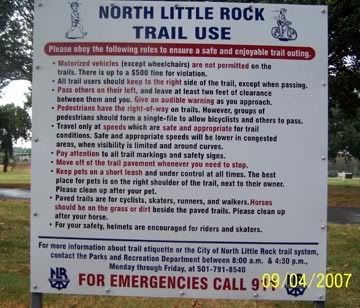
Similar signs are posted over on the Little Rock side of the River Trail. Does anybody pay attention to them? You can probably see this one coming...
As I said, there's not a single good answer. Here's how I deal with the question in my Road I and other bike safety classes, from my class notes:
[quote]
In order to stay safe, it is imperative that bicyclists, the fastest users, yield to slower users. Because there are so many different users, it is hard to get everyone to follow the same rules. Runners don’t know if they should run on the right or left side, roller-bladers can easily take up the entire lane as they sway back and forth, children are erratic and unpredictable, and adults usually assume that they can just let the kids go.
If you do use multi-user paths, you must yield to everyone as you are the fastest user and have the greatest responsibility. What cars are to bicyclists on the road, bicyclists are to pedestrians on the paths. Be responsible.
Bicyclists Sharing the Path
Despite cyclists feeling that their true enemy is the automobile, it could be held that the conflict between bicyclists and pedestrians is most threatening to cyclists’ rights. The problem is not that pedestrians and bicyclists cannot co-exist, but that we have never been taught how to deal with each other. Bicyclists can learn how to ride in traffic from books or friends, or by applying principles they learned when they were taught to drive a car, but techniques for dealing with pedestrians, either on bike paths or on streets are not as well-known.
Fortunately, much of what we’ve learned about riding in traffic will readily apply to riding the bike paths, too…
Run, ride, walk, skate – on the right. You will still conflict with club runners who believe they should be going against traffic, but you must watch out for these jokers in any case.
Pass only on the left – not on the right. People don’t expect anyone to be coming up on their right side.
Always yield to pedestrians (more in a little bit...)
Ride at a speed that’s appropriate for the traffic density on the trail. The River Trail, or any other multi-use trail, is simply not a place to hold your fast pack rides or practice your time-trialing.
Yield to Pedestrians: Don't ever assume a pedestrian is looking out for you. If you hit a pedestrian, it is going to be considered your fault even if you have the right of way. Legally, the pedestrian always has the right of way. It is your responsibility to be aware of and be prepared for all the thoughtless, crazy moves that pedestrians will make.
Pedestrian Reactions
The first principle in dealing with pedestrians from a bike is that they don't know how to deal with you, either. Unlike automobiles, which can be directed by the bicyclist into proper action, pedestrians are less likely to react to a bicycle even if they see them.
Remember, a properly tuned bike is almost silent; those on foot may be listening rather than looking for trouble. Bells let people (including non-English speakers) know a cyclist is coming. But to get the attention of drivers and peds, nothing beats the human voice. "YO!" "Stop!" "Coming through!" or even a loud "Excuse me!" do the trick. The goal: Let them know where you are, where you are going, and what you want them to do. What I’ve found to work for me is a simple greeting as I approach from the rear, reinforced by a bike bell for the ones who don’t respond to a voice.
Still, don't count on people responding. The law calls for using extra caution to avoid pedestrians, regardless of right-of-way. If things get dicey, hit the brakes. Hitting a ped will stop you just as quickly as hitting a solid object, and the repercussions are far more serious. Riding unnecessarily close to peds ("buzzing" them) scares them and endangers both of you and is the worst publicity cyclists can get. A slight miscalculation or last-minute move can cause a serious (and seriously stupid) accident.
With cooperation, we can get and keep pleasant places to bicycle and walk. With conflict, we could lose the paths we have and have to fight larger forces to maintain our full access to city streets.
You can increase your safety by increasing your awareness of traffic conditions. Don’t take the blame. Do take charge of your own situation.
Tom
-
05-12-2008, 07:55 AM #6
In-app purchases
- Join Date
- Sep 2007
- Location
- Uncanny Valley
- Posts
- 14,498
Great tips Tom.
I'd add another one: NO iPODS and NO PHONES (for anyone using the paths)!!! In close quarters where people depend on audible warnings - and where posted rules may require audible warnings - the person being warned should at least have the courtesy not to drown out the warning.
But to answer rabbit's question: yes, it was them and not you who was being rude. In similar situations (and since I rarely take the road bike onto the trail, so I'm normally on the hybrid), rather than slow down, I'll very conspicuously veer into the grass, so they'll know they ran me off the road. Not that they probably care.Last edited by OakLeaf; 05-12-2008 at 07:57 AM.
Speed comes from what you put behind you. - Judi Ketteler
-
05-12-2008, 08:10 AM #7
Shine on...
- Join Date
- Mar 2007
- Location
- Minneapolis, Minnesota
- Posts
- 502
I would say, of course you're allowed your lane...
...but don't expect it to be given to you.
That's why I don't ride many of the paths anymore. I get too ticked off by the lack of common courtesy. 2007 Trek 5000
2009 Jamis Coda
1972 Schwinn Suburban
"I rejoice every time I see a woman ride by on a bike. It gives her a feeling of self-reliance and independence the moment she takes her seat; and away she goes, the picture of untrammelled womanhood."
Susan B. Anthony, 1896
-
05-12-2008, 09:48 AM #8
Ride your ride.
- Join Date
- May 2006
- Location
- Md suburbs of Wash. DC
- Posts
- 2,131
I'll add one little tip to this, one that I picked up from Bicycling magazine and have found makes a huuuge difference on the multi-use trails that I frequent: Originally Posted by PscyclePath
Whether you're using your voice or a bell, you need to warn people far enough in advance to give them time to be startled and then figure out what to do. I usually whistle or yell "Bicycle behind you!!" when I'm a few hundred feet from pedestrians or slower cyclists and the response is pretty much always the same: They'll generally turn around and see me, swivel their head around while they assess the situation, make a decision, then move to one side or the other. I will then steer towards the side that they've left clear for me and say hello or thank you as I go by.
It's also worked a few times ("Bicycle ahead of you!") for people taking up too much space coming towards me. The one thing it doesn't work on is those doofii who insist on wearing earphones "How about if we all just try to follow these very simple rules of the road? Drive like the person ahead on the bike is your son/daughter. Ride like the cars are ambulances carrying your loved ones to the emergency room. This should cover everything, unless you are a complete sociopath."
David Desautels, in a letter to velonews.com
Random babblings and some stuff to look at.
-
05-12-2008, 10:03 AM #9
In through the out door..
- Join Date
- Aug 2005
- Posts
- 4,516
I did the off road thing on Saturday. We were riding on a bike trail at Duke, and came upon a group of students walking side by side, taking up the *entire* path. They *would not* move over. I contemplated stopping and making like a tree so they would *have* to move or walk into a fixed object. I went around on the grass, waved and shouted thank you (it had been a bad day...)
CAMost days in life don't stand out, But life's about those days that will...
-
05-12-2008, 10:13 AM #10
Registered User
- Join Date
- Sep 2006
- Location
- Washington, DC
- Posts
- 1,632
Common courtesy and common sense should be protected species. Originally Posted by northstar
-
05-12-2008, 10:53 AM #11
Sue
- Join Date
- Jun 2005
- Location
- Illinois
- Posts
- 3,151
The 15 or so of us on our Saturday Saunter were taking the MUS out of town and I was in front... so I pretty-close-to-literally brayed at the headphone-laden jogger as we approached (since we were already making a fair amount of noise and had called out "jogger up!" ... and I had this horrible laryngitis so I sounded rather donkeyesque anyway)... and she jumped and got out of the way and gave us a thumbs up and a smile...
... but I thought... gosh and golly, lady, you think that's what people should *have* to do to get your attention?
I kinda like doing both road and path on this route since it's educational. My beginner level riders can see the advantages and disadvantages to the path... and then for most of the ride we're on the roads, anyway.
-
05-12-2008, 11:24 AM #12
Registered User
- Join Date
- Jul 2006
- Location
- Flagstaff AZ
- Posts
- 2,516
This is what I try to do - is give plenty of warning - but of course, this is difficult if there are lots of people on the trail. The other day I gave lots of warning to two ladies on a down hill section who were walking next to each other going the same way I was going - I was overtaking them; They were walking along, I said bike coming - on your left - and they both proceeded to bump into each other and almost knock each other down, then look behind and finally realize after some more jostling which way to go. It was fairly fun to watch. Originally Posted by Kalidurga
spoke
-
05-12-2008, 11:44 AM #13
Of sky 'n earth
- Join Date
- Nov 2007
- Location
- Western Canada-prairies, mountain & ocean
- Posts
- 6,984
Would agree with others that as a cyclist, you should expect your own lane in a bike path/multi-purpose path, but don't expect it to be granted to you.
There are some multi-purpose paths in our city that I studiously avoid during certain hours of the day. However such paths have served me excellently ...early in the morning. I don't diss such paths, because for me, some paths if geograhically designed in an ideal manner, one can avoid over 30 different 4-way/traffic light intersections on the road..(this is very true in City of Toronto where I was commuting from suburbs into downtown).
I would say 75% of time, I use the bell...and give advance warning. Other times it's verbally..."on your left". Usually the latter is useful for joggers and other folks who look more athletic in their activity/attire.
Some of our paths are heavily promoted ...for tourists or they are near rental bike stores/rollerblade shops. It is abit disconcerting particularily not the tourist cyclists wobbling...but the tourist rollerbladers, of whom, you can see, some folks are very unsteady on their rollerbladers.Last edited by shootingstar; 05-12-2008 at 11:47 AM.
-
05-12-2008, 11:56 AM #14
back of the autobus
- Join Date
- Dec 2003
- Location
- Folsom CA
- Posts
- 5,667
This is why I dislike multiuse paths, and why I think they're often considerably more dangerous than riding on the road.
2009 Lynskey R230 Houseblend - Brooks Team Pro
2007 Rivendell Bleriot - Rivet Pearl
-
05-12-2008, 01:46 PM #15
gravel grindess
- Join Date
- Jul 2007
- Location
- foothills of the Ozarks aka Tornado Alley
- Posts
- 4,193
Yeah, I feel this way about shoppers in Wally World. They hog the middle of the aisle with their cart and don't give one hooey about others. Oh, and the dawdlers who take their time walking as a group down the middle of the street as you are patiently waiting to pull into a parking place. Originally Posted by northstar