As of yesterday, I have just over 600 miles on the bike. Most of my riding is on level rail-trails. When I do get out on hills, it's usually pretty small ones. I don't have too much trouble with a short, steep hill, but those long, lower gradient ones really get to me. Yesterday, though, when I was heading uphill on a 2-3% gradient for 15 miles and ended up pedaling 95rpm/10mph, I was totally disgusted.Originally Posted by DebW
Just what happens when you switch to cogs with larger spacing? Is it harder to shift? Does it not fit as well on the bike frame?
There's been kind of a flurry of threads on this subject lately, so I'm apparently not the only person wanting to tweak her gearing. It's been a great learning experience to read all of the comments and it's really appreciated!
Welcome guest, is this your first visit? Click the "Create Account" button now to join.


Results 1 to 13 of 13
Thread: Cross-chaining
Hybrid View
-
08-25-2006, 08:22 AM #1
 Ride your ride.
- Join Date
- May 2006
- Location
- Md suburbs of Wash. DC
- Posts
- 2,131
"How about if we all just try to follow these very simple rules of the road? Drive like the person ahead on the bike is your son/daughter. Ride like the cars are ambulances carrying your loved ones to the emergency room. This should cover everything, unless you are a complete sociopath."
David Desautels, in a letter to velonews.com
Random babblings and some stuff to look at.
-
08-25-2006, 10:38 AM #2
Grease Monkey
- Join Date
- Jan 2006
- Location
- Massachusetts
- Posts
- 2,556
Switching to a cogset with an overall wider range means that the steps between gears are larger. The shifting will be not quite as quick, though not really any harder. More importantly, those wider steps between gears just make it harder to find the gear that gives you the perfect cadence. That's the trade-off: fine gradations to find the perfect gear, or a wide range (with a low low) but always wishing there was another gear between two of your gears. Originally Posted by Kalidurga
With your 48-34 front and 12-25 rear cogs, you get the following gears (I'm using Sheldon Brown's chart assuming you have 700x28 wheels and listing results in gear inches):
48 front: 107, 99, 86, 76, 68, 61, 56, 51
34 front: 76, 70, 61, 54, 48, 43, 40, 36
But if you eliminate the cross-over gears (2 on each end nominally, but you may decide that more or less need to be eliminated):
48 front: 107, 99, 86, 76, 68, 61
34 front: 61, 54, 48, 43, 40, 36
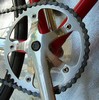
you have almost no overlap (only a 61 on both chainrings, but the 48-61 may be somewhat of a cross-over so you may want to eliminate it too). The reason you're getting no overlap is because the chainrings are spaced far apart. This gives you a wide range of gears without putting on a widely-spaced cassette (i.e. you get nice quick shifts in the rear). This setup had advantages. If you want a gear between 61 and 107, you stay in the big chainring and shift the rear. If you want a gear between 36 and 61, you stay in the small chainring and shift the rear. But from 61 to 68, you have to shift the front derailleur up one (harder) and the rear derailleur down two (easier). That's a pain-in-the-butt shift, but it's an 11% jump compared to the 9-11% jumps between your other gears, so everything is nicely spaced and not overlapped. On paper, this is a very nice gearing setup, unless you find yourself making that 61-68 shift all the time, i.e. if that gear ratio is something you use a lot on flat to gently sloping ground. Though if you find that the 61 work fine on either chainring, you have a choice of making the double shift between 61-68 or 54-61. If you decide you hate this setup, there are certainly other combinations you could try, with closer spacing in the chainrings and wider spacing on the rear cogs. But that would have its compromises too.Oil is good, grease is better.
2007 Peter Mooney w/S&S couplers/Terry Butterfly
1993 Bridgestone MB-3/Avocet O2 Air 40W
1980 Columbus Frame with 1970 Campy parts
1954 Raleigh 3-speed/Brooks B72
-
08-25-2006, 12:16 PM #3
crazy fixed roadie
- Join Date
- Jul 2006
- Location
- LA County
- Posts
- 77
If you are seaching for lower gears the most practical solution would be to swap your 8 speed cassette with a mountain cassette, 12-28, 12-30, or even 12-32. The only catch is your rear short cage derailleur most likely will not be able to handle the larger cog, thus requiring you to swap the derailleur with a long cage. Originally Posted by Kalidurga
-
08-25-2006, 08:43 PM #4
Registered User
- Join Date
- Jun 2006
- Location
- Boise, Idaho
- Posts
- 1,104
Originally Posted by Kalidurga
Okay, I understand about newbies and not-so-newbies and I understand about speed, I covet speed, but, you went up a 15 mile long hill at ten miles per hour????
I WANNA GROW UP TO BE YOU!!!!!
Someday, maybe I too will be able to be disgusted by ten miles per hour going up hill. For now I'll settle for being disgusted by four miles per hour up hill. And I'll continue to hope for getting to the point where I can be disgusted by five miles per hour up hill....
And now back to our regularly scheduled cross-chaining thread, which has been very interesting!
Karen in Boise
-
08-26-2006, 05:13 AM #5
Ride your ride.
- Join Date
- May 2006
- Location
- Md suburbs of Wash. DC
- Posts
- 2,131
Oops, I didn't realize what I said could sound obnoxious... Originally Posted by Kano
 But you have to understand the hill in question. Let me digress a bit to clarify what I was dealing with:
We're talking a gradient of 2-3%. A grade of that small degree looks perfectly flat to the eye. During the first half of my ride, I flew along, pedaling the most comfortable stroke ever at my fastest speed ever maintained beyond a .25 mile. Then, when I turned around to head back on what looked like a flat trail, I was immediately struggling. In higher gears, my legs began to feel like lead. In lower gears, I quickly fatigued myself with spinning. To be working that hard on a hill that just plain doesn't look like a hill is what got me disgusted. As much effort as I was putting in on a seemingly flat surface, it felt like I should have been flying. The only gears in which I could turn a comfortable, smooth stroke at any speed were the ones in which I was cross-chained: the inner cogs with the big ring, or the outer cogs with the small ring. I spent that 15 miles thinking that either I need to do some serious cardiovascular work, or I need a greater range of gears-- which led to my original post in this thread.
What I still can't figure out is why I was more comfortable cross-chained when, according to the gear ratio charts discussed, I should have had similar gearing in a non-crossed combo. I think I need to take the chart from Sheldon's site and DebW's explanations, get on my bike, and run through the gears. Looking at the chart and paying attention to the different feel of each combination is probably what I need to make all of this "click" in my head.
It's funny... I've been biking for years, but it's only in the last year or two that I've begun thinking about what it is that I'm doing. Time to admit that, in that respect, I'm just a newbie "How about if we all just try to follow these very simple rules of the road? Drive like the person ahead on the bike is your son/daughter. Ride like the cars are ambulances carrying your loved ones to the emergency room. This should cover everything, unless you are a complete sociopath."
David Desautels, in a letter to velonews.com
Random babblings and some stuff to look at.

 Reply With Quote