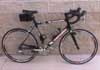
OK. Last time I wanted to change a cog set, I purchased the tools from my LBS, and in showing me how to use the tools they changed it for me. Today, I did it myslef for the very first time. I think I did it correctly, but here is the problem. The bike is my husband's. He was running a 53/39 in front with a 12/23 casette in back and what looks to be a very short cage rear derailleur (all durace 9). The new casette we ordered is 12/25. First DH replaced his chain before going out of town. By mistake he made it a link shorter than the old chain. The new casette arrived today. It seemd to install smoothly (yey, my first time!), and I got the rear dearailleur adjusted so it would shift nicely (mostly all I fiddled with was the barell adjustor on the tension, or whatever that knob is that lets you make fine adjustments in the tension), but I noticed a problem when in the small front ring and large rear ring. The part of the derailleur that hangs down in back hits the spokes of the wheel. Is this because a 25 tooth cog is too large for a short cage rear derailleur, or because the chain is too short? If its the derailleur, can I even find a 9 spd durace rear derailleur anymore, and if so which one do I need (or maybe easier he could go back to a 12-23 casette, he was OK with it but on a very hilly ride last weekend one of the racer boys commented he'd be better off with a 12-25 and since it was worn and needed replacing he decided to try it. Please help, as I am supposed to have the bike ready for us to go on a ride early saturday, and he is getting back from his trip tomorrow nite.
Welcome guest, is this your first visit? Click the "Create Account" button now to join.


Results 1 to 15 of 22
Hybrid View
-
09-07-2006, 07:39 PM #1
 Registered User
- Join Date
- Feb 2006
- Location
- San Antonio, TX
- Posts
- 2,024
Rear Derailleur is Hitting Spokes, HELP PLEASE
-
09-07-2006, 09:02 PM #2
Registered User
- Join Date
- Jan 2006
- Location
- San Francisco, CA
- Posts
- 1,080
Sounds like you need a longer chain. Be careful when in the big/big combo (not recommended anyways because you're cross-chaining, but it happens, right?). Your rear derailleur could get sucked up into your cassette.
Not that I know from personal experience or anything.....

On my tour last summer, I had this happen. Needed one more link in my chain. Since I couldn't do that, we had to lock out the derailleur so I couldn't use the largest cog on the cassette.
-
09-07-2006, 09:40 PM #3
Registered User
- Join Date
- Feb 2006
- Location
- San Antonio, TX
- Posts
- 2,024
I think you are right. I researched more on the capacity of the derailleur and it should be fine. I thought it was just a link too short, but when I compare it to other bikes in the house it looks a lot too short. GRRR, after getting the derailleur so nicely adjusted I have to start over. Do you know if I can add links back just anywhere (I still have the excess chain that was removed) or should I use the starter link. DH did the chain cuz I had trouble getting the pins in and out, but maybe if I practice on the old chain first, or does it really take a lot of hand strength?
-
09-08-2006, 02:54 AM #4
Grease Monkey
- Join Date
- Jan 2006
- Location
- Massachusetts
- Posts
- 2,556
You can put chain links back in. Obviously you have the chain tool. You probably want it a couple links longer than the old chain. If you have a power link in this chain, remove that and start there. Otherwise break it anywhere. Starting to drive out a pin can be a bit tricky. Make sure the chain tool is really centered over a pin - you may have to back off and try this a couple times before you're perfectly centered and the pin will start moving through the near plate. It can take enough force to make your hands uncomfortable if the tool is small. As you push the pin out (this also applies to the small piece of chain you are going to reinsert), push the pin until it is almost flush with the inside plate but still sticks out to the inside a tad. This will make it easier to start reinserting. If you leave that tad bit of pin inside the plate, you'll have to bend the chain link sideways a bit to pull the chain apart. As you're driving the pin out and getting near the end, stop and pull the tool off and try to break the chain by twisting and pulling. If it won't come yet, go another 1/2 turn and try again. Do that until it comes apart.
To put in the new links, attach the new piece of chain to the long chain. If you left that tad of pin inside the plate, it will snap in. If not, you'll have to hold the chain ends together as you start driving the pin with the chaintool (it can be done, but it feels like you need at least 3 hands to do it). Start slowly (and back off and try again if necessary) and make sure the tool is really centered over the pin. Once it gets started, it should drive in easily. Stop when the pin is centered between the outer plates. Now remove the tool, but don't lose that link. The link you just drove together will normally be stiff, that is, it won't bend freely. So now you use the "stiff link" part of the chain tool. The chaintool will have 2 places to hold the chain, one at it's end which you used to drive the pin out and in, and another in the middle. The one in the middle is for stiff links. Put the chain there (if the chain pin is not perfectly centered, put the longer end by the chaintool pin). The idea is to nudge the pin of the chain so that the link (with no pressure from the tool on it's backside) spreads just a little. Bring the tool down snug against the pin and then turn it 1/8-1/4 turn. Remove the chain and see if it moves freely. If not, repeat the procedure another time or two until it does.
One caution: apparently some Shimano chains (don't know which ones or what years or if they still do this) required a new pin every time you broke the chain. Check the box that came with your chain.
If you have enough chain, it will be possible to shift into the big-big combination on the work stand. Check the L limit screw on the derailleur to make sure the derailleur doesn't go further than the inside cog. With the chain on the smallest chainring, pedal fast on the work stand and make the shift to the inside cog repeatedly. Turn the L screw until you can't make that shift, then back it off until the shift occurs comfortably. Don't turn it any further than necessary. If you find the derailleur still hitting spokes after all this, then perhaps the new cassette sits closer to the wheel than the old one. A spacer behind the cassette could fix this. Only other cause would be a bent derailleur or hanger, but unlikely since he had no problems before. Good luck.Last edited by DebW; 09-08-2006 at 06:58 AM.
Oil is good, grease is better.
2007 Peter Mooney w/S&S couplers/Terry Butterfly
1993 Bridgestone MB-3/Avocet O2 Air 40W
1980 Columbus Frame with 1970 Campy parts
1954 Raleigh 3-speed/Brooks B72
-
09-08-2006, 04:20 AM #5
Grease Monkey
- Join Date
- Jan 2006
- Location
- Massachusetts
- Posts
- 2,556
chain length
The other thing to check about chain length is that when you go into the small-small combination, there is no chain slack. So when you are about to put the chain together, put it in that combination and by hand pull the chain to where the links you plan to rivet together are in line. You should be pulling the rear derailleur jockey wheels out of their slack position and fighting tension in the derailleur spring. If you're doing that and you have enough chain to go into the big-big combination, the chain length is generally OK. Though some derailleurs will work better within some range of jockey wheel angles.
Oil is good, grease is better.
2007 Peter Mooney w/S&S couplers/Terry Butterfly
1993 Bridgestone MB-3/Avocet O2 Air 40W
1980 Columbus Frame with 1970 Campy parts
1954 Raleigh 3-speed/Brooks B72
-
09-08-2006, 07:50 AM #6
Registered User
- Join Date
- Feb 2006
- Location
- San Antonio, TX
- Posts
- 2,024
Wow, you guys are great. Looking at it this morning, I am pretty sure the chain is simply too short, cuz if I hold it as if there were a few more links the rubbing stops. Also, my husband made it one link shorter than before, but since the casette is larger it probably should have been 1 link longer so it is actually now 2 links short. I will fix it after work tonite, but I am wondering if part of my problem with the chain tool I have is that I bought one that is mobile for traveling, but perhaps harder to use. Deb, can you please recommend a really good chain tool and I'll stop by my LBS and pick it up on my home from work tonite. I know in the short term I am spending more on tools than service, but in the long term its worth. I LOVE being able to keep our bikes running well.

 Reply With Quote